Move Well · Stay in the Game

Injury Prevention for Growing Athletes

Young athletes are getting hurt younger, and many of those injuries can be prevented. Here's what every sports parent should know about growth spurts, warning signs, and the simple daily work that keeps kids healthy.

Why Kids Get Hurt

Strong Muscles, Growing Bones

During a growth spurt, bones get longer faster than muscles and tendons can keep up. Muscles get tight and pull hard on the places where they attach to bone, and in kids those attachment points sit on growth plates, which are softer than adult bone.

So a strong, fast kid can produce more force than those spots can handle. That's why we see heel pain, pain below the kneecap, and even avulsion fractures, where a hard sprint, kick, or jump pulls a small piece of bone away with the tendon.

Add year-round games and very little time spent on mobility or strength, and it's a recipe for injury. The good news: this is trainable. Mobility keeps muscles from getting tight, and slow, controlled strength work (especially isometric holds) helps tendons and the bone around them get used to load.

Know the Warning Signs

Where Growing Athletes Hurt

These are some of the most common pain spots in young athletes. Any of them is worth a visit to your doctor or a pediatric sports medicine provider.

Heel

Back of the heel

Heel pain with running and jumping, often in kids around 8–14. Commonly Sever's disease, irritation where the Achilles attaches to the heel's growth plate.

Knee

Just below the kneecap

A sore, sometimes swollen bump below the kneecap, common in the early teen years. Often Osgood-Schlatter, from the thigh muscles pulling on a growth plate.

Hip & Pelvis

Sudden sharp hip pain

A sharp pain (sometimes a "pop") in the front of the hip or the sit bone during a sprint, kick, or jump. Can be an avulsion fracture. Stop and get it checked.

Most common in teens in sprinting and kicking sports.

Low Back

Back pain that won't quit

Low back pain that lasts, especially with arching or twisting (gymnastics, volleyball, football, dance), should be evaluated, not pushed through.

See a doctor when there's:
  • Sudden sharp pain, a pop, or a limp
  • Swelling, or pain at a specific spot that you can press on
  • Pain at night or at rest
  • Pain that lasts more than a week or two, or keeps coming back
  • Pain that changes how they run, jump, or play

We're coaches, not doctors. This page is general education, not medical advice.

Smart Load

The Parent Playbook

Most youth injuries are overuse injuries, and most of these habits come straight from the American Academy of Pediatrics.

Rest

1–2 days off a week

No more than 5–6 days of practice and games a week. Recovery is when they actually get stronger.

Ramp up slowly

10–20% at a time

Don't jump weekly training time by more than 10–20%. Big spikes (camp week, tournament stacks) are when kids break down.

One team

One team per season

If they're on two teams, avoid practices or games for both on the same day.

Seasons

2–3 months off a sport

Take at least 2–3 months a year off from any one sport. Those breaks can be split up.

Listen

Pain isn't toughness

Pain after practice, then during practice, then at rest is how overuse injuries progress. Catch it early.

Build the base

Train the athlete

Mobility, strength, and landing skills protect them. Practice teaches the sport; it rarely teaches the body how to handle it.

Daily Mobility Routine

8 minutes · no equipment

Do it before practice, after practice, or while watching TV. Hips, ankles, hamstrings, and upper back are where young athletes get tightest during growth spurts.

  • Knee-to-wall ankle rocks — 10 each sideFoot a few inches from the wall, drive the knee toward the wall, heel stays down.
  • Deep squat hold — 2 × 30 secHeels down, chest up, elbows gently pushing knees out. Hold the doorframe if needed.
  • 90/90 hip switches — 8 each sideSit with both knees bent at 90°, rotate both knees side to side, tall chest.
  • Half-kneeling hip flexor stretch — 30 sec each sideSqueeze the glute of the back leg. The stretch should be in the front of the hip, not the low back.
  • Inchworms — 5Walk hands out and back with legs as straight as comfortable. Great for hamstrings.
  • Open books (lying on side) — 8 each sideKnees stacked, rotate the top arm open and follow it with your eyes.
  • World's greatest stretch — 4 each sideBig lunge, elbow to the inside of the front foot, then reach that arm to the sky.
From the Ground Up

Train the Feet

Every Sportgility class opens barefoot with a foot and ankle series: toe yoga, short foot, and big-toe presses. Shoes mute the signal, so the shoes come off.

Strong feet and ankles absorb landings better, push off harder, and take stress off shins, knees, and Achilles. It's the cheapest, most ignored gain in youth sports.

The free Bulletproof Routine below includes the same foot work we do in class.
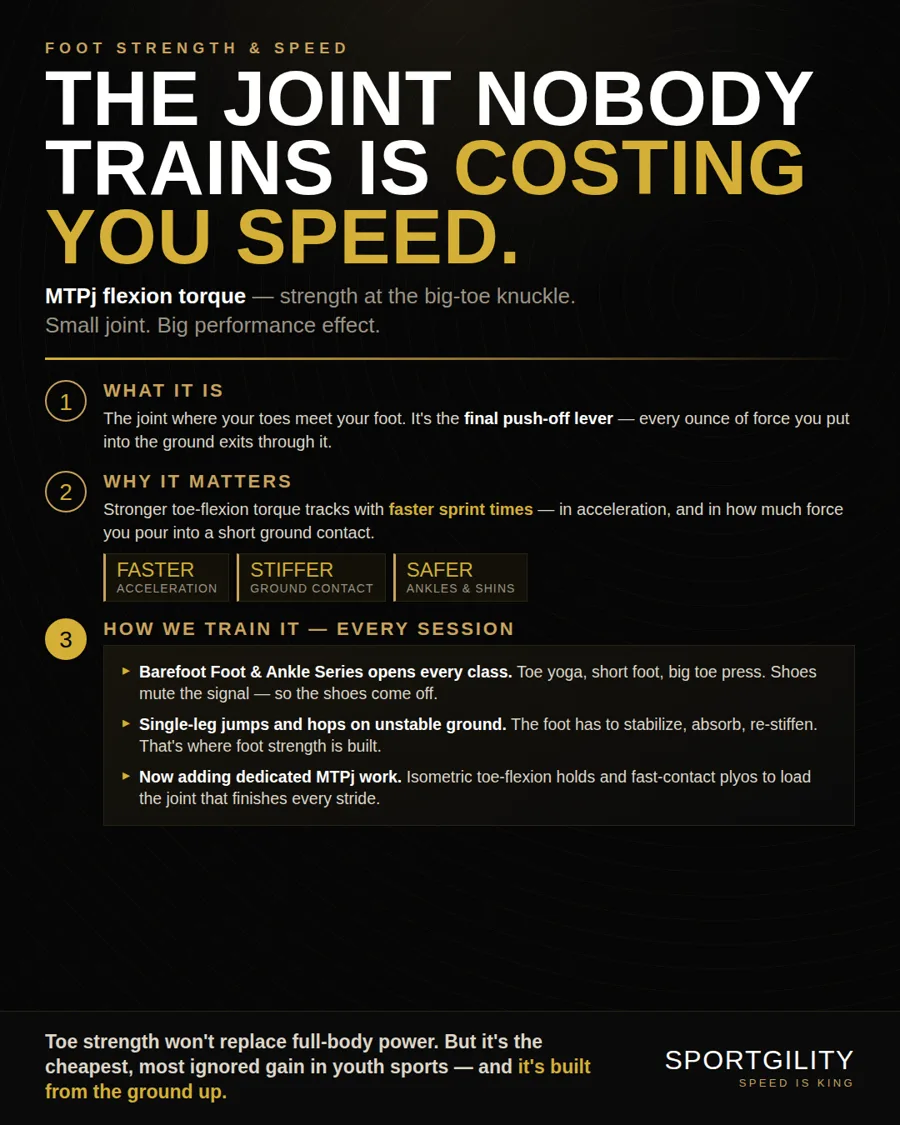
Sportgility foot strength and speed graphic
Free for Parents

The 10-Minute Bulletproof Routine

The isometric holds and foot work we use to help young athletes' tendons, knees, hips, and ankles handle what their sport throws at them. Three to four times a week, no equipment.

No spam. The plan, plus an occasional tip for raising a healthy athlete. Unsubscribe anytime.

Want Eyes on Your Athlete?

Every Accelerate class includes mobility and injury-prevention work, coached in person. Your athlete's first class is free.

Try a Free ClassGet a Full Assessment